
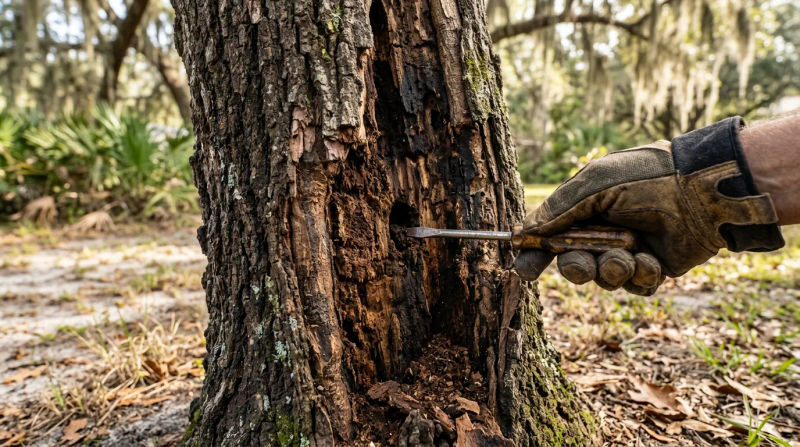
It’s a beautiful October afternoon in Ocala, and you’re enjoying the cooler, drier air in your yard. Your gaze lands on the majestic oak tree that has stood on your property for decades, a landmark for your home. But this time, you notice something different - a cluster of shelf-like fungi growing near the base, or maybe a long, dark crack running up the trunk that you don’t remember seeing before. While the canopy might still look full and green, these subtle clues can be the first whispers of a serious, hidden problem: tree internal decay.
In my 12 years as a tree care specialist, I’ve seen countless trees that appeared perfectly healthy on the outside but were dangerously weak on the inside. This is especially common with the mature oaks and pines that grace many Ocala properties, including those in neighborhoods developed in the 1990s and 2000s where large, established trees were preserved. Understanding the warning signs is the first step in protecting your property from a sudden and catastrophic tree failure, particularly as late-season wind events can test a tree's limits.
Common Signs and Symptoms
Detecting internal decay requires a bit of detective work. The tree can't tell you what's wrong, but it leaves behind plenty of evidence. When our crews perform a tree risk assessment, these are the key indicators we look for. Here are some of the most common internal rot signs oak tree owners and others should watch for:
- Fungal Growth (Conks or Mushrooms): This is one of the most definitive signs. Fungi growing on the trunk, at the base of the tree, or on major roots are the “fruiting bodies” of the decay organism living inside. Their presence means the decay process is already well-established. Don't ignore them.
- Cracks and Deep Seams: Look for deep vertical cracks in the trunk. These can be caused by stress, lightning, or rapid temperature changes. While some are superficial, deep cracks provide a direct pathway for moisture and fungi to enter the heartwood, accelerating tree internal decay.
- Hollows and Cavities: Obvious holes are a clear indicator, but even old pruning wounds that never properly sealed can become entry points for rot. If you have a hollow trunk tree, what to do is have its structural integrity assessed immediately. A hollow trunk doesn't automatically mean removal, but it requires a professional evaluation to determine how much solid wood is left to support the tree.
- Canopy Dieback: Are there numerous dead branches at the top of the tree? Is one side of the canopy thinning out or losing leaves prematurely? This often indicates that the trunk or root system is compromised and can no longer transport sufficient water and nutrients to the extremities.
- Swollen or Fluted Base: A tree may try to compensate for internal weakness by growing additional wood around a decayed area. This can result in a swollen, bulging, or fluted appearance at the base of the trunk. It’s the tree’s version of a natural brace, but it’s a sign of a significant underlying problem.
- Pest Activity: While insects like carpenter ants don't cause the decay, they are excellent opportunists. A heavy infestation of carpenter ants often means they are excavating nests in soft, rotting wood. Their presence is a strong secondary symptom of decay.
- Sudden Leaning: If your tree develops a noticeable lean that wasn't there before, or if you see the ground heaving or mounding at the base opposite the lean, it could signal severe root rot. The tree's anchoring system is failing, and it poses an immediate risk.
What Causes This Problem
Internal decay isn't a disease a tree “catches” like a cold. It’s a natural process initiated by a combination of factors that compromise a tree’s defenses. Understanding the cause can help you prevent it in your other trees.
The primary culprit is almost always a physical injury. A tree’s bark is its armor. Once that armor is breached, the vulnerable wood inside is exposed. Common causes of injury include:
- Improper Pruning: Leaving large stubs or making flush cuts that damage the branch collar creates wounds that the tree cannot seal effectively.
- Storm Damage: Broken branches and torn limbs from high winds create large, jagged wounds that are prime entry points for decay fungi.
- Mechanical Damage: Wounds from lawnmowers, string trimmers, or vehicles bumping into the trunk are very common and often occur at the critical base of the tree.
- Construction Stress: In many Ocala neighborhoods with homes built in the 1990s-2000s, the mature trees that add so much value may have suffered root damage or soil compaction during construction. This old injury can take decades to manifest as significant internal decay.
Once an injury occurs, fungal spores, which are always present in the environment, land on the exposed wood. With moisture, they begin to grow, slowly breaking down the non-living heartwood at the center of the tree. The tree will try to wall off the decay through a process called compartmentalization, but a large or aggressive fungal infection can overwhelm these defenses over time.
When to Call a Professional
While you can spot the external signs, you can't see what's happening inside the trunk. Assessing the extent of internal decay and the associated risk is a job for trained professionals. We use specialized techniques, such as sounding the trunk with a mallet to listen for hollow sounds, and sometimes employ advanced diagnostic tools to measure the thickness of the remaining solid wood wall.
So, when to remove a decaying tree Ocala FL homeowners ask? The decision is based on a professional risk assessment that considers three factors: the likelihood of failure, the environment it's in (e.g., near a house, patio, or street), and the potential consequences of that failure.
You should call a qualified professional for an inspection immediately if you notice:
- Large conks or mushrooms growing directly on the main trunk.
- A new or worsening lean, especially if accompanied by ground cracking or heaving.
- A crack that extends deep into the trunk or runs through more than half its circumference.
- More than 50% of the tree’s canopy appears dead or is rapidly declining.
An expert can determine if the tree is an acceptable risk, if risk can be mitigated through pruning or cabling, or if removal is the only safe option.
Conclusion
Your mature trees are a valuable asset, but their health should never be taken for granted. The biggest takeaway is that a tree can look healthy from a distance while hiding a critical structural flaw. By regularly inspecting your trees for the key signs - fungal growth, cracks, cavities, and canopy dieback - you can catch problems early. Don't wait for a storm to reveal a weakness that was there all along. Being proactive is the best way to ensure the safety of your home and family.
If you notice any of these signs, contact a local tree service professional for an inspection.